

3 Types of Struggle (And How to Know Which One Your Kid Is In)

Updated: Mar 13
Struggle is one of those parenting words that can make our stomach tighten.
Because on one hand, we want resilient kids—kids who can handle disappointment, work hard, and bounce back.
On the other hand, we don’t want our kids to hurt. And sometimes “struggle” is a warning sign, not a life lesson.
So, here’s a helpful filter I like to use at home:
There are three different types of struggles, and your job changes depending on which one your kid is in.

The 3 types of struggles (at a glance)

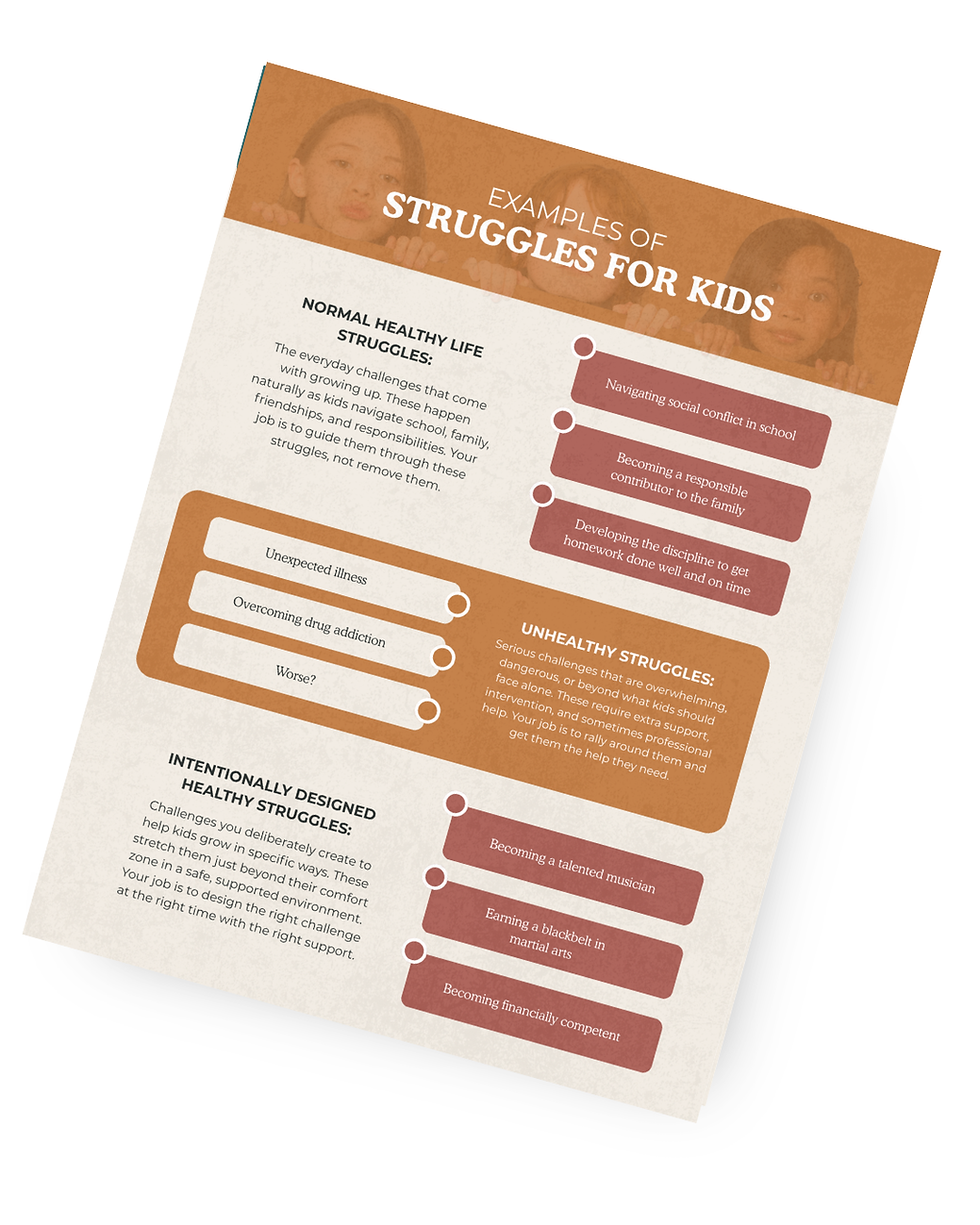
Normal, healthy life struggles (everyday challenges that grow kids over time)
Unhealthy struggles (overwhelming,
dangerous, or beyond what a child should carry alone)
Intentionally designed healthy struggles (challenges you choose on purpose to build skills)
Let’s walk through each one—what it looks like and what to do next.
1) Normal, healthy life struggles

These are the everyday challenges that come with growing up. They’re uncomfortable, yes—but they’re also normal and often necessary for maturity.
Your role: Guide them through the struggle, not remove it.
Think: coach, not snowplow.
What it can look like
Navigating social conflict at school (a friend is upset, someone said something rude, group dynamics shift)
Becoming a responsible contributor at home (remembering chores, helping without constant reminders)
Developing discipline for schoolwork (getting homework done well and on time)
What to do (practical parenting moves)
Name the struggle without panic.
“That sounds hard. Friend stuff can feel really heavy.”
Help them problem-solve, but don’t take over.
“What do you think your next step could be?”
Build endurance in small reps.
If homework is the struggle, the win might be: sit down, start, and do 10 focused minutes.
Stay steady.
Kids borrow our nervous system. If we act like it’s an emergency, they’ll feel like it’s an emergency.
A “Dinner Table” script
“I’m not going to fix this for you, but I’m 100% here with you. Let’s figure out your next right step.”
2) Unhealthy struggles

What it is
These are struggles that are overwhelming, dangerous, or beyond a child’s ability to handle with normal support. This is where parents sometimes get stuck—because we want kids to be “tough,” so we minimize… when actually, help is the brave move.
Your role: Step in, stabilize, and get the right support.
Think: protector, advocate, team-builder.
What it can look like
Unexpected serious illness (or ongoing health issues that disrupt daily life)
Substance use or addiction (or patterns that suggest risk, dependency, or unsafe behavior)
Other examples might include: self-harm, suicidal ideation, abuse, severe anxiety/depression, eating disorders, unsafe relationships, chronic bullying, or trauma.
What to do (practical parenting moves)
Take it seriously early. You don’t need “proof” to offer support.
Widen the circle. Loop in professionals and trusted adults: pediatrician, counselor/therapist, school counselor, pastor/mentor, recovery resources.
Focus on safety and support, not punishment.
Even when there are boundaries, the tone is: we’re moving toward help.
Keep your connection.
Your child may push you away. Don’t interpret that as “they don’t need you.”
A “Dinner Table” script
“This is bigger than willpower, and it’s not something you have to carry alone. We’re going to get help, and I’m staying close.”
If you’re unsure: When in doubt, treat it like it matters and consult a professional. It’s always okay to ask, “Is this within normal development—or is this outside the guardrails?”
3) Intentionally designed healthy struggles

What it is
These are challenges you choose on purpose because they build strength, skill, and confidence. They’re not random hardships; they’re structured opportunities to grow.
Your role: Design the challenge, provide support, and let the work be real.
Think: trainer, scaffolder, encourager.
What it can look like
Becoming a talented musician (practice, feedback, performing)
Earning a black belt in martial arts (discipline, patience, perseverance)
Becoming financially competent (budgeting, earning, saving, planning)
These are powerful because they teach kids: effort connects to outcomes—and they learn to stay in the learning curve without quitting.
What to do (practical parenting moves)
Make the struggle “just-right.”
Not so easy it’s pointless; not so hard it crushes them.
Normalize the learning curve.
“It’s supposed to feel hard at first—that’s how we know you’re learning.”
Support the process, not just the result.
Praise practice, consistency, and resilience more than talent.
Teach recovery.
Rest, hydration, nutrition, sleep, emotional regulation—these are part of training too.
A “Dinner Table” script
“You don’t have to love every minute of practice. But if this goal matters to you, we’ll build a plan—and we’ll stick with it.”
How to tell which type of struggle your kid is in

If you’re stuck, ask these three questions:
1) Is this struggle expected for their age and stage?
If yes, it’s likely normal, healthy life struggle.
2) Is this struggle unsafe, overwhelming, or escalating?
If yes, treat it as unhealthy struggle and get help.
3) Is this struggle tied to a chosen goal with support and structure?
If yes, it’s likely intentionally designed healthy struggle.
And remember struggles can shift categories. A “normal” struggle can become unhealthy if it spirals or if a child’s support system collapses. You’re not trying to label your kid—you’re trying to choose the right response.
What parents often get wrong
(and how to correct it)

Mistake #1: Rescuing from normal struggle
Result: kids learn “I can’t” faster than they learn “I can.”
Try instead: small coaching + small independence.
“Show me what you’ve tried so far.”
Mistake #2: Treating unhealthy struggle like a discipline issue
Result: shame, secrecy, and a kid who gets better at hiding.
Try instead: boundaries + support + professionals.
“We’re taking steps to keep you safe, and we’re doing this together.”
Mistake #3: Designing “growth” struggles that are actually too big
Result: burnout, dread, quitting, or anxiety.
Try instead: right-size the challenge and adjust the load.
“Let’s make this doable and build up from there.”
FAQs: 3 Types of Struggle

1) Isn’t it my job to make life easier for my kids?
It’s your job to make life safe and supported, not necessarily easy. Some “hard” is how kids build capability. The key is matching your response to the type of struggle.
2) How do I support without rescuing?
Try this three-step rhythm:
Empathize (“That’s frustrating.”)
Get curious (“What part is hardest?”)
Coach one step (“What’s your next move?”)
3) What are signs a struggle is unhealthy?
Big ones include safety risks, self-harm talk, substance use, drastic mood/behavior changes, ongoing sleep/appetite disruption, panic, intense withdrawal, persistent hopelessness, or anything that feels bigger than normal stress and isn’t improving with basic support.
4) What if my kid refuses help?
Stay calm and widen the circle anyway. You can still consult a pediatrician or therapist as a parent and ask, “How do I approach this?” Also: keep connection points open—rides, meals, short check-ins—without interrogations.
5) How do I choose a good “designed struggle”?
Look for something that:
your child has at least some interest in,
builds a useful skill (discipline, teamwork, service, money, movement),
has a clear path for progress,
and includes healthy adults/coaches and safe structure.
6) How much struggle is too much?
If your child is constantly flooded—meltdowns, shutdowns, dread every day—reduce the load. Even good challenges need recovery and margin.
One small next step for this week
At dinner (or in the car), try this simple question:
“What was something hard today—and what helped you get through it?”
You’re not just collecting information.
You’re teaching your child:
Struggle is normal. Support is available. And you can do hard things.
Download the Free Resource
If you want to start building healthy money awareness without pressure, this is a simple place to begin. No charts. No lectures. Just thoughtful questions that fit into everyday life.
Financial literacy starts with conversation. And even the smallest conversations can shape how kids understand responsibility for years to come.


Comments